Location
Belgium
Industry
Soil remediation
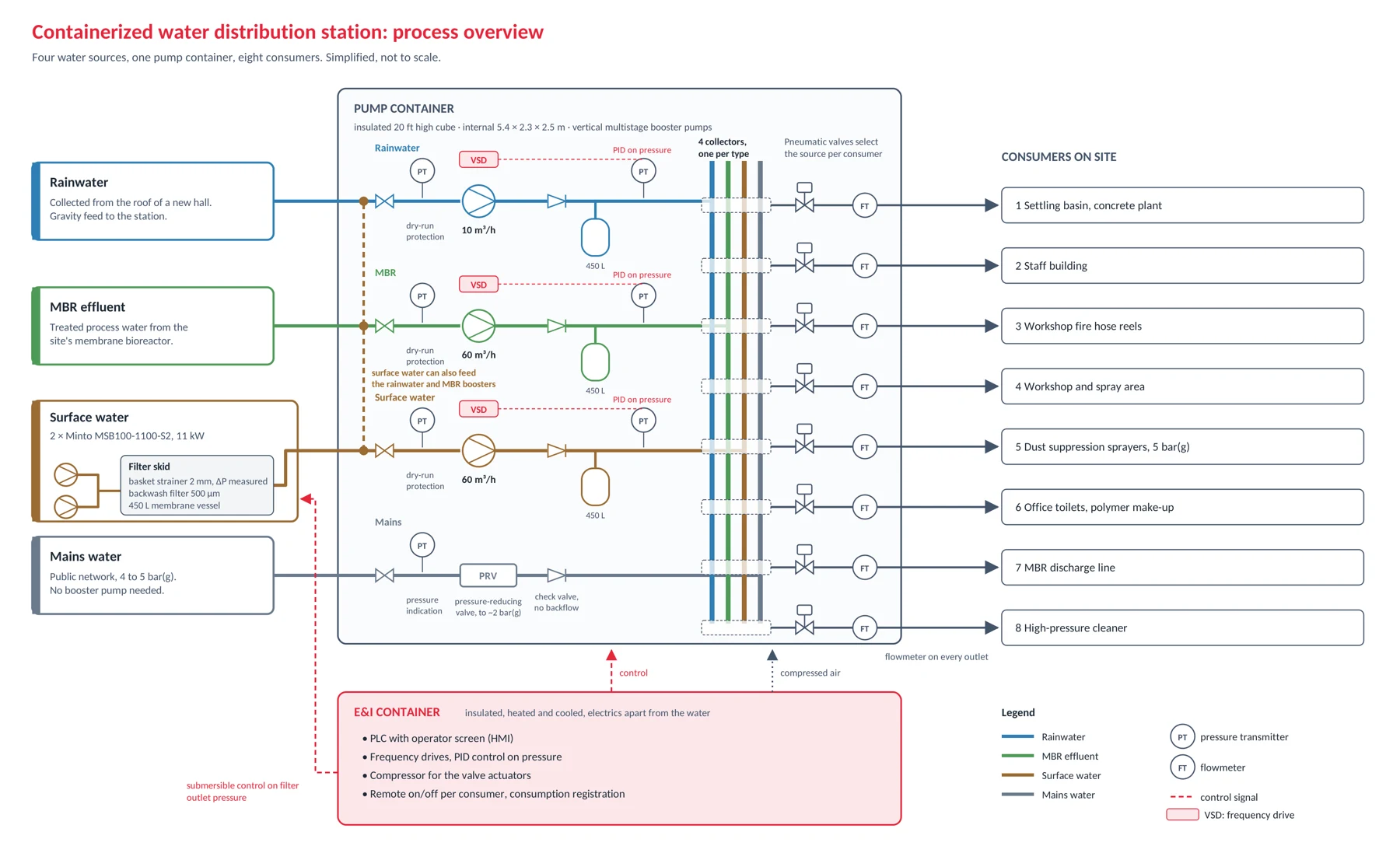
Four sources to eight consumers.
Rainwater, treated process water, surface water and mains water go to every consumer that can use them, from one control screen.
Constant pressure, changing demand.
Speed-controlled booster pumps hold an adjustable discharge pressure as consumers switch on and off.
Consumption measured per outlet.
Every outgoing line has its own flowmeter, so the site knows what each consumer uses.
Built in the Vaikon workshop.
Pump and control equipment in two insulated 20-foot containers, delivered ready to connect.
Challenge
An expansion with a new concrete batching plant and a washing plant meant this site had to rethink its water supply. Four sources were available: mains water, rainwater from the roof of a new hall, treated process water from the site's membrane bioreactor (MBR) and surface water from an adjacent waterway. Eight consumers draw on them, from the settling basin of the concrete plant to dust suppression sprayers, workshop fire hose reels and office toilets.
The station had to connect every consumer to the water type it needs, record what each consumer takes and fit in an insulated 20-foot container. The dust suppression nozzles need 5 bar(g), while the consumers on mains water need the incoming 4 to 5 bar(g) reduced to about 2 bar(g).
With consumers switching on and off at any moment, the pumps have no fixed duty point.
Solution
Vaikon built the station as two containers. The insulated pump container holds the booster pumps, collectors, valves and flowmeters. A second container houses the PLC, the frequency drives, the operator screen and the compressor for the valve actuators, with its own heating and cooling, away from the water.
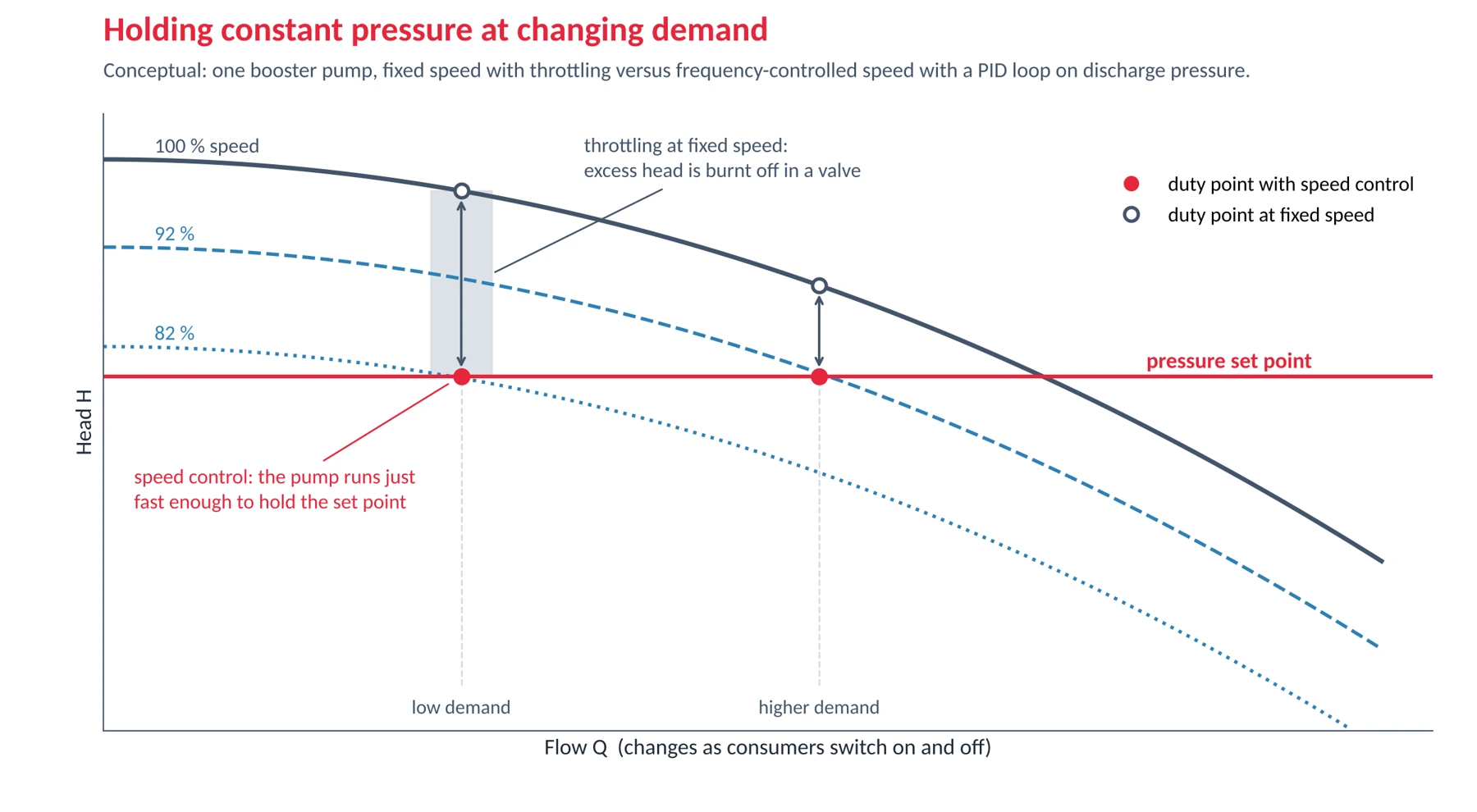
Four ways to hold pressure under changing demand were compared: throttling, a bypass line, several pumps in series or parallel, and speed control. Throttling and bypassing turn energy into heat or recirculated flow, and extra pumps need floor space and a known flow per consumer. The choice was one vertical multistage pump per water type on a frequency drive, PID-controlled on discharge pressure. The surface water and MBR pumps deliver 60 m³/h each, sized for 5 bar(g) at the sprayers, with a working range of 30 to 80 m³/h. The rainwater pump delivers 10 m³/h. A 450-litre membrane vessel keeps the network pressurised at low demand, so the pumps do not cycle on every small draw. Mains water only needs a pressure-reducing valve and a check valve.
Inside the station
Because the sources arrive with some inlet pressure, dry-run protection uses a pressure sensor in each pump suction instead of a flowmeter. That saves straight pipe, which drove the layout of a container 5.4 metres long: eight diameters ahead of every pump, plus straight runs around each flowmeter. Rainwater, MBR water and surface water are metered electromagnetically, with no moving parts to wear or foul.
Pneumatically actuated Krux DN100 knife gate valves switch the consumers. Surface water comes from two Minto MSB100-1100-S2 submersible pumps of 11 kW, through a filter skid with a 2 mm basket strainer and a 500 µm automatic backwash filter. The submersibles are pressure-controlled on the filter outlet pressure, and a differential pressure measurement over the basket strainer shows when it is fouling.
Control logic
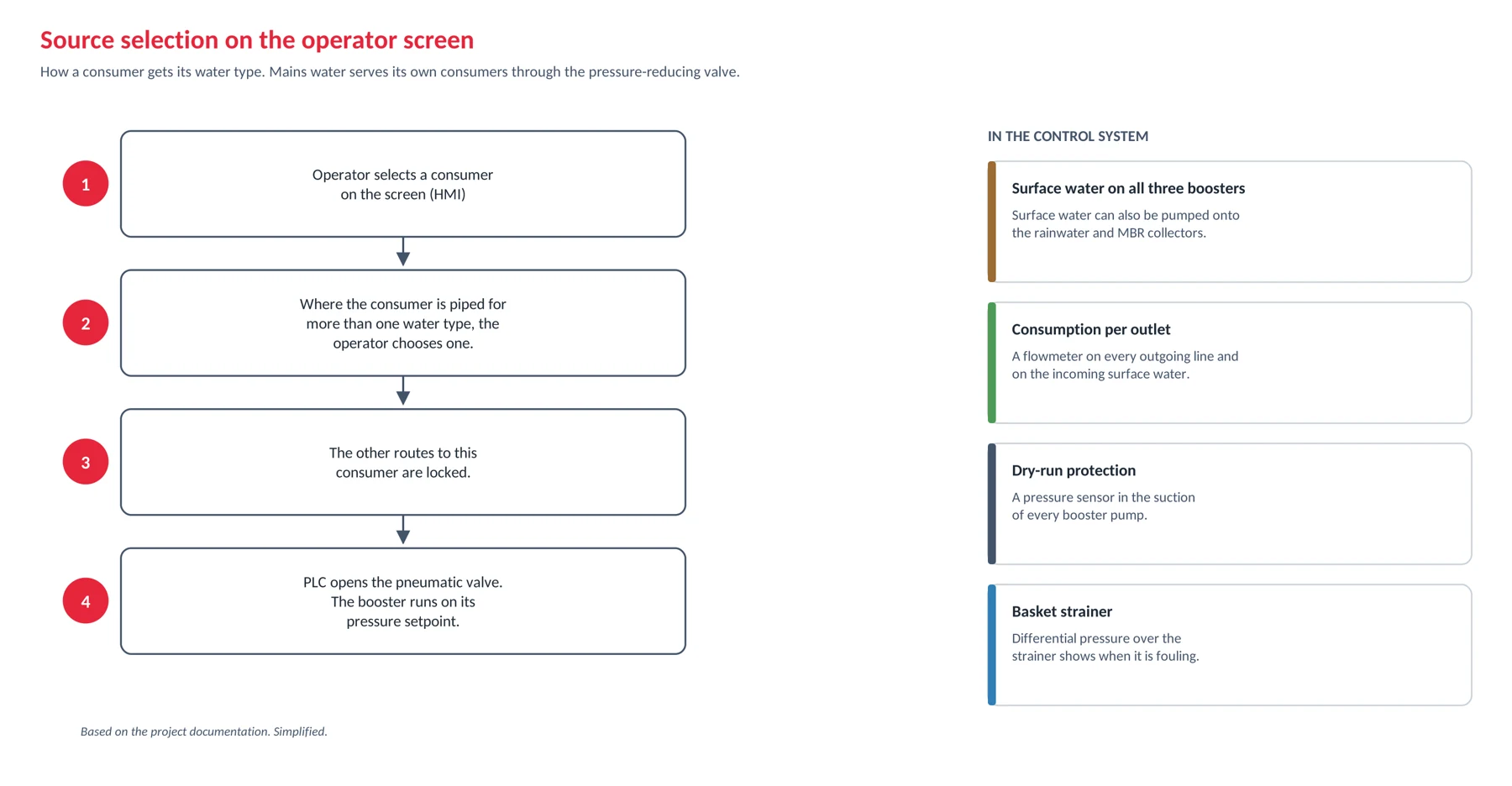
Every consumer is switched on or off from the operator screen and assigned a water type. Where a consumer is piped for more than one water type, the operator chooses one and the other routes to that consumer are locked.
Surface water can be pumped by all three booster pumps, so it can also supply the rainwater and MBR collectors. The pressure setpoint of each booster is adjustable in the PLC.
Surface water intake
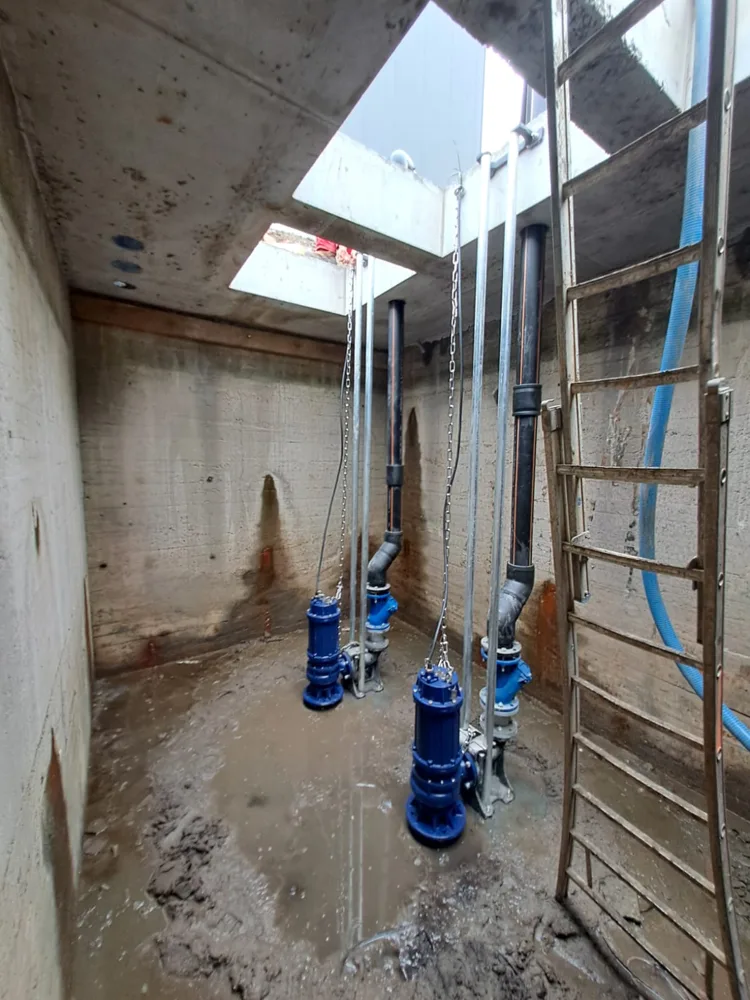
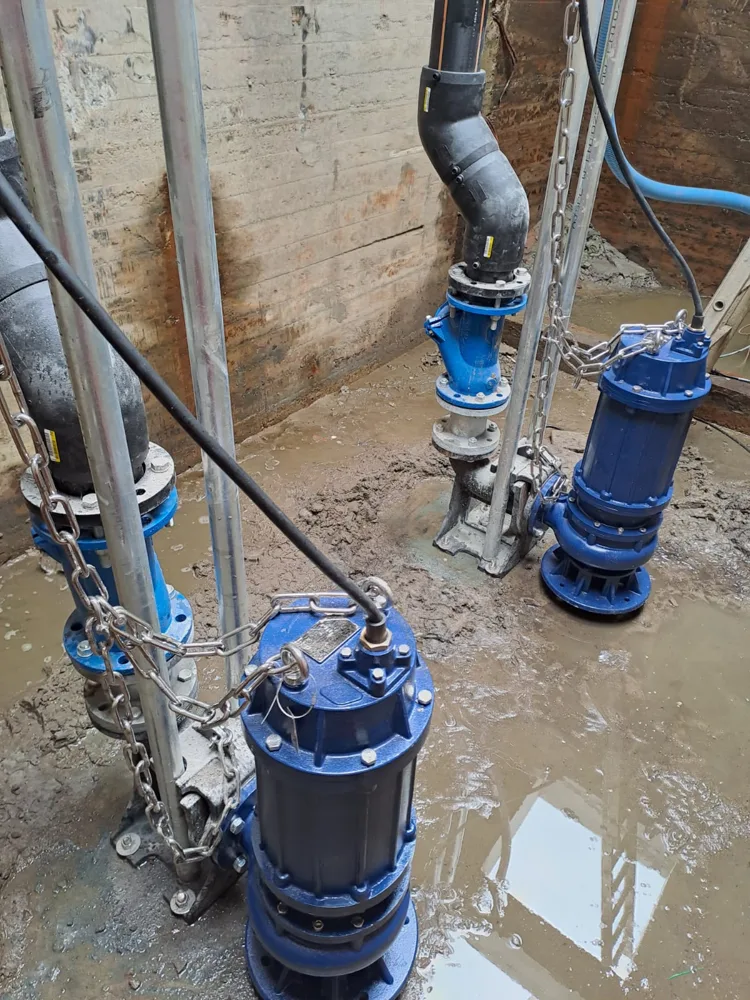
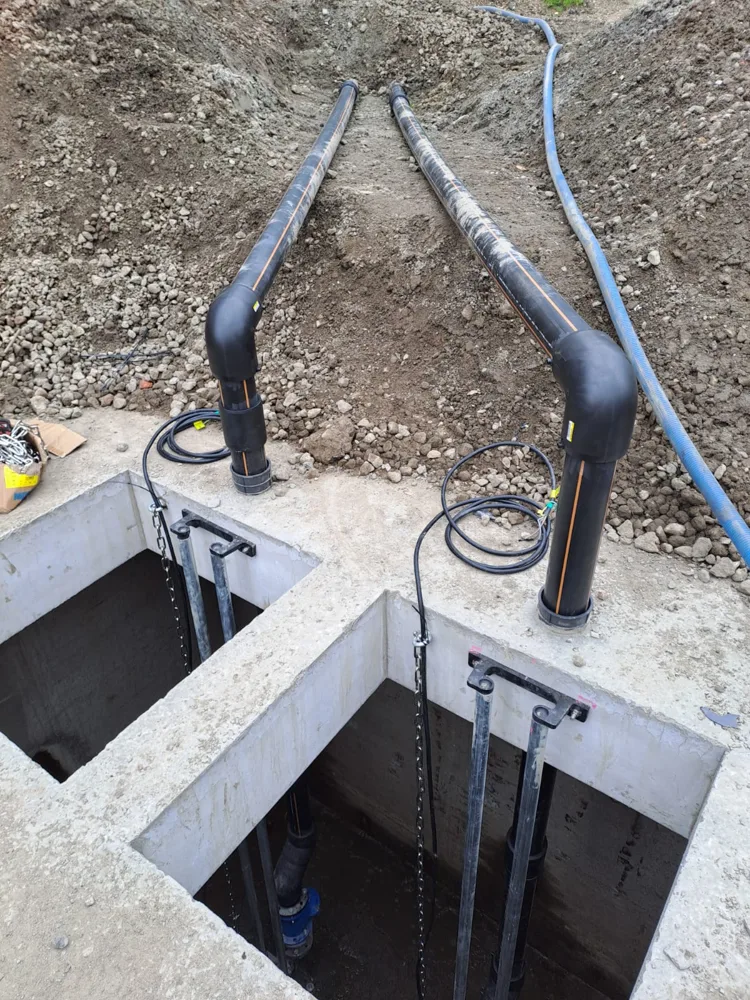
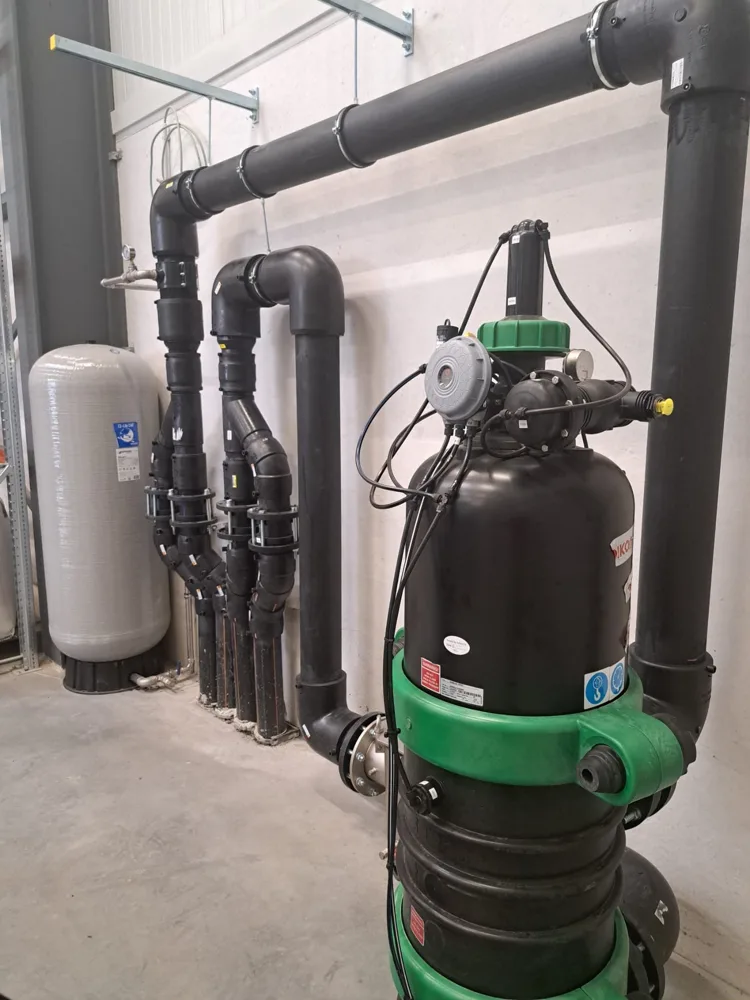
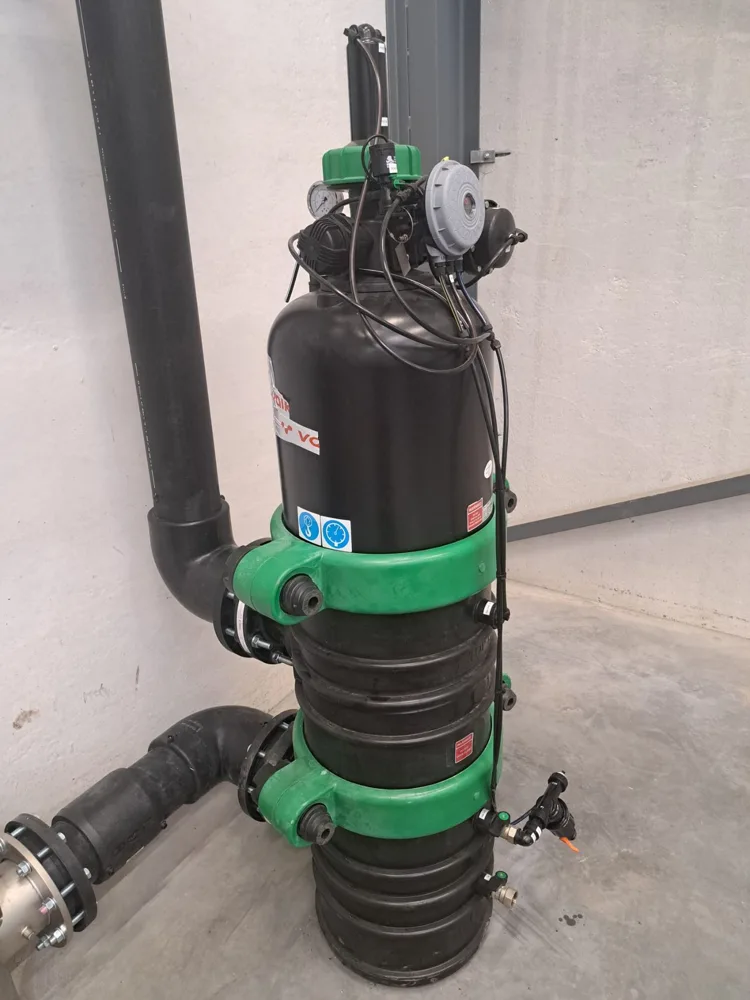
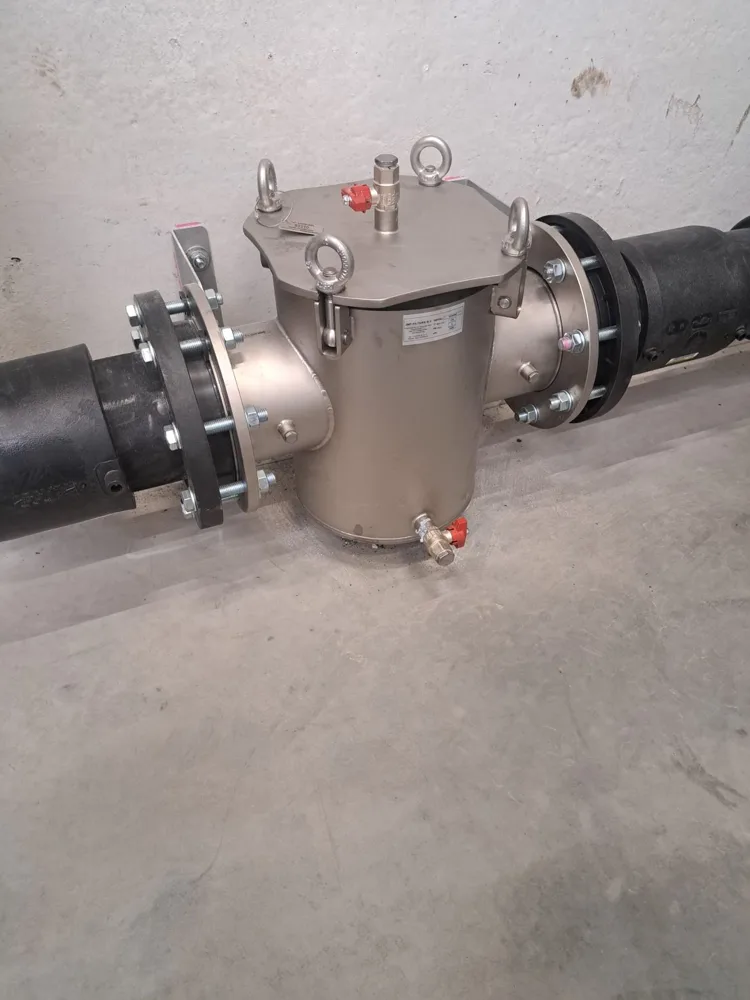
Two Minto MSB100-1100-S2 submersible pumps in the intake pit lift surface water from the adjacent waterway. Their discharge lines run to the filter skid, where a 2 mm basket strainer and a 500 µm automatic backwash filter clean the water before it reaches the pump container.
Inside the pump container
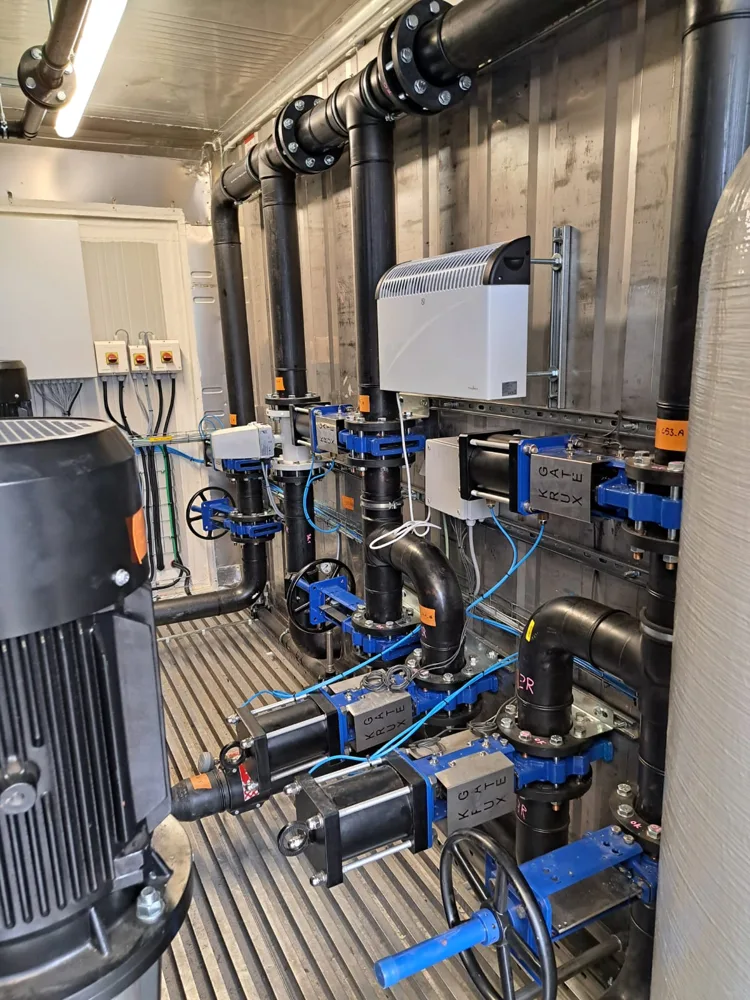
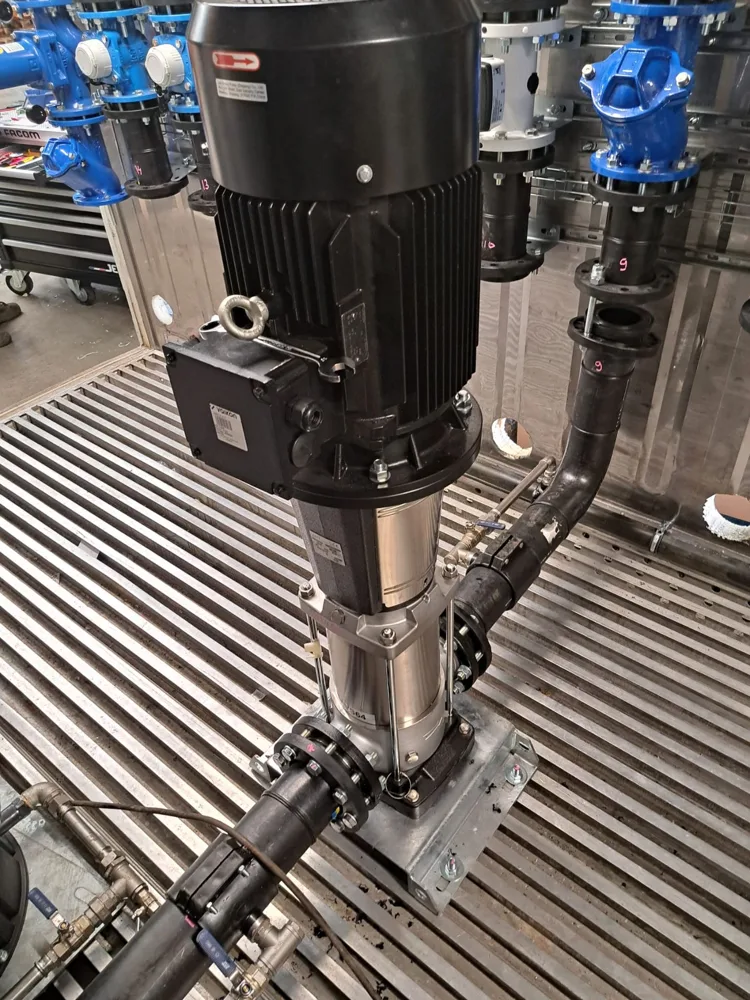
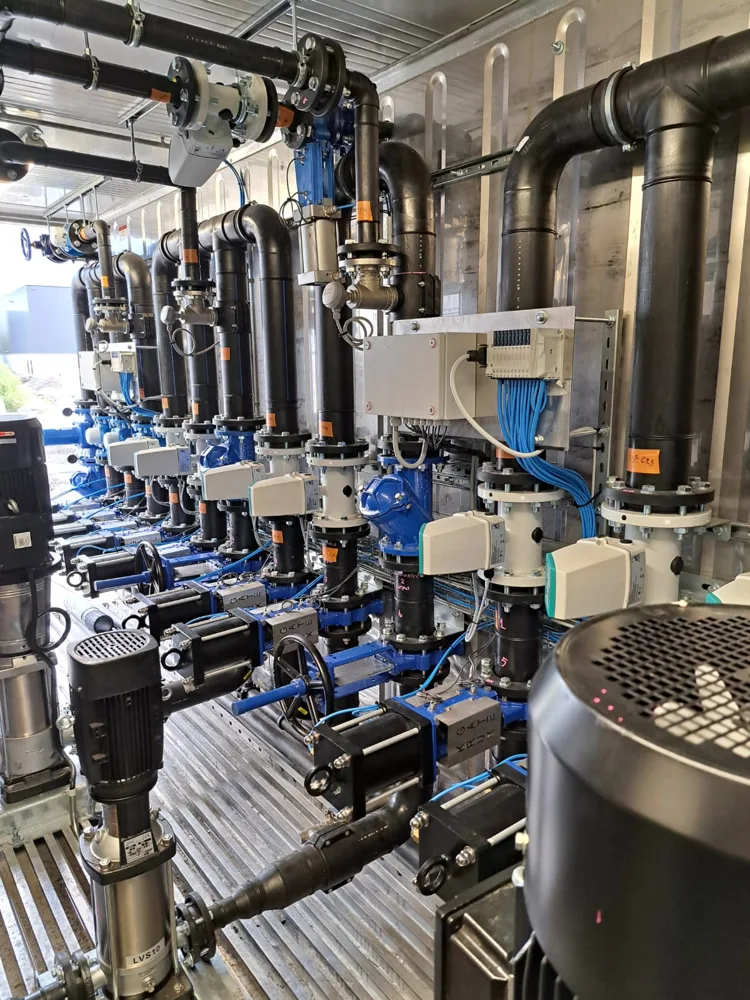
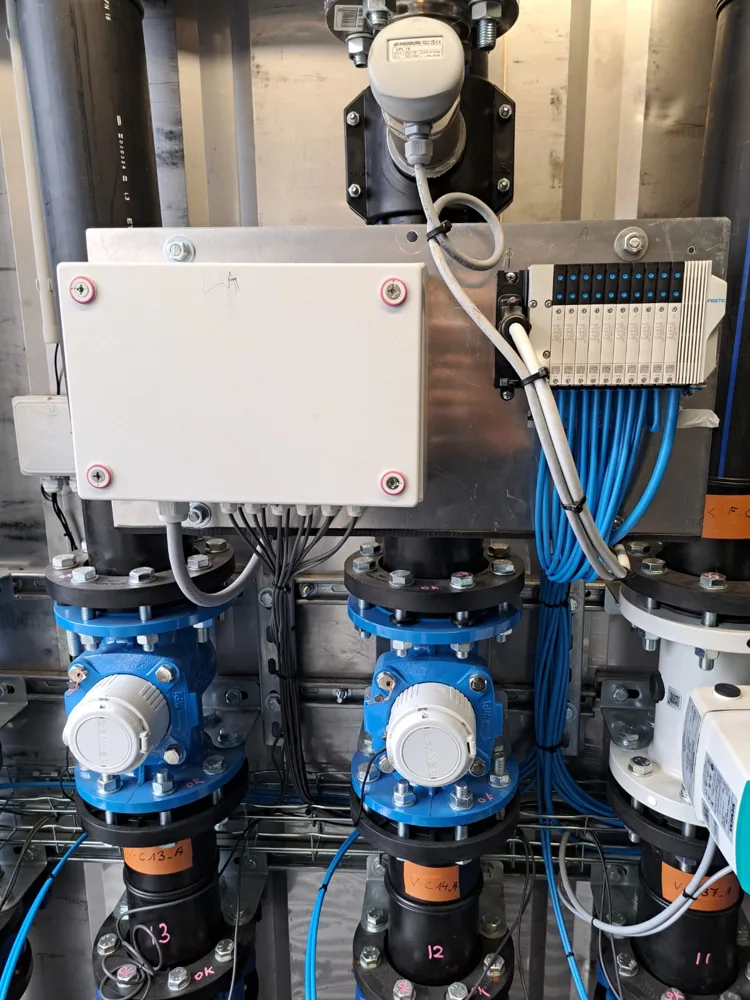
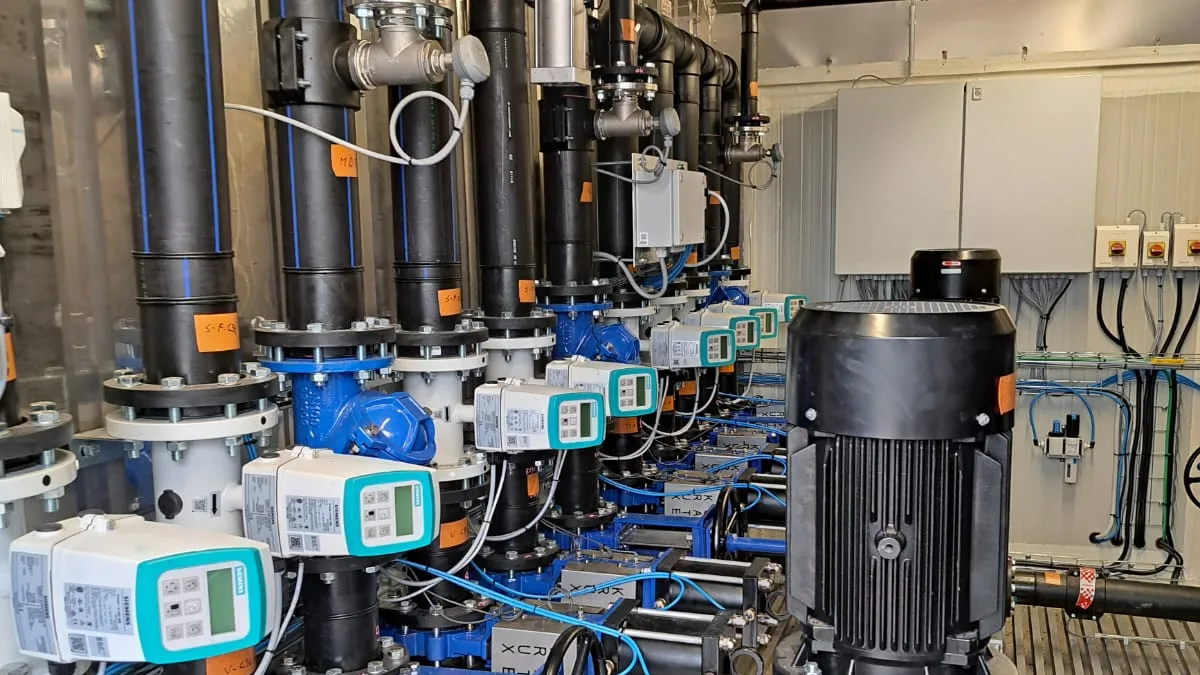
One vertical multistage booster pump per water type, each on its own frequency drive. Every outlet has a pneumatically actuated knife gate valve and a flowmeter, and a valve island on the collectors drives the actuators with compressed air from the E&I container.
Result
The station now handles the water distribution across the site. From one screen, the operator assigns a water type to each consumer and switches it on or off, and the consumption of every outlet is registered.
The booster pumps run at the speed the demand asks for, and the drives show the power each pump draws. Built and wired in the Vaikon workshop, the station arrived on site as two containers ready to connect.