Challenge
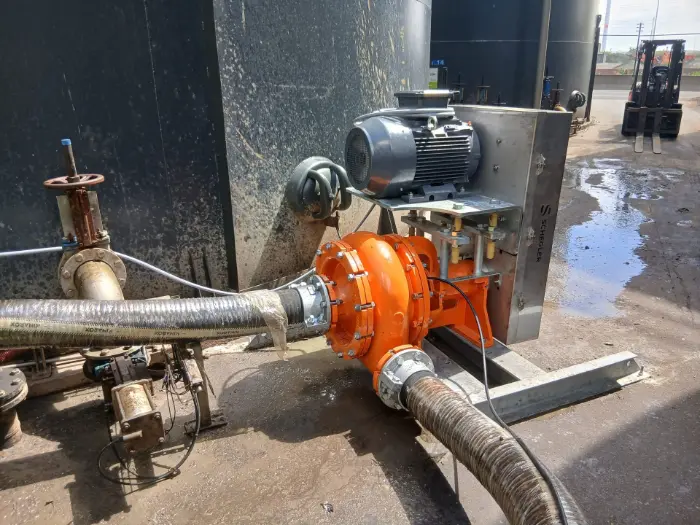
At a biogas site in Belgium, organic residual streams are digested into green energy, with a soil improver and nutrients as by-products. The site runs several digesters in continuous operation, and the feed pump on one of them was wearing through parts faster than the team wanted to plan around.
A Vogelsang* rotary lobe pump (type VX186-130Q) was handling the duty. It's a solid choice for many digester feeds, but this stream carries long fibres left over after the material has been cut, and they put heavy wear on the lobes. As the lobes wore down, the pump needed a higher speed to hold the same flow rate, cycle after cycle, roughly 1.85% more by the end of each two-week run.
The numbers made the pattern clear: a full set of lobes had to be replaced every two weeks, 26 times a year, each swap costing about 20 minutes of downtime. Add up the wear parts, the wear plates, the seals and the gearbox wear that comes with that pace, and the site was looking at roughly 8 to 9 hours of downtime a year on lobe changes alone, on top of a steadily rising parts cost.
Location
Belgium
Industry
Biogas
No cure, no pay, in writing
Vaikon
installs, commissions and stands behind the pump for three months. If the wet
end parts don't hold up, the client gets a second attempt or a full refund, not
just a warranty clause.
A recessed impeller solves a fibre problem
The Schegler Vortex's recessed impeller lets long organic fibres pass around it instead of through it, cutting the wear that forced 26 lobe changes a year on the previous pump.
The business case holds without counting downtime
Even leaving out the cost of production stops, the swap pays for itself in under two years and more than twice over across five, on maintenance and running cost alone.
Solution
Vaikon proposed a Schegler Vortex horizontal slurry pump, sized for 60 to 120 m³/h at 3 bar, for a medium with a specific gravity (SG) of 1.2. Where a rotary lobe pump moves material between two lobes, a recessed vortex impeller sits back in the casing: the medium flows around it instead of through it. Less contact with the impeller means less wear, and long fibres pass through the casing instead of wrapping around moving parts.
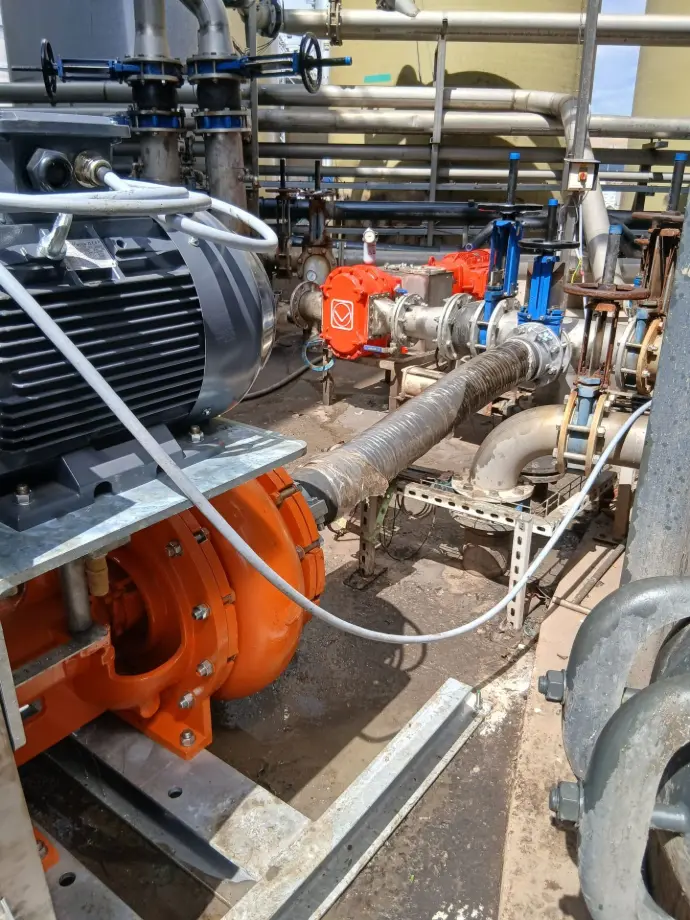
The pump was assembled in Vaikon's workshop in Lommel on a top mount base plate, driven by a 30 kW motor through a belt drive, with high chrome (27%) wear parts on the impeller and casing, gland packing on the seal, and a grease-lubricated heavy-duty bearing assembly.
This pump type was new to the customer, and switching pumps on a running digester is not a decision you take lightly. To make that step easier, Vaikon proposed a no cure, no pay approach: the customer only pays once the pump proves itself in operation. The delivery, installation and commissioning took a single day, and after three months, we will inspect the wet end parts together with the customer to confirm how the solution is holding up.
The saving comes entirely from fewer wear-part changes and less downtime, not from energy. Even without counting the cost of the downtime itself, left out deliberately to keep the model conservative, the pump pays for itself in under two years and more than twice over across five.
Result
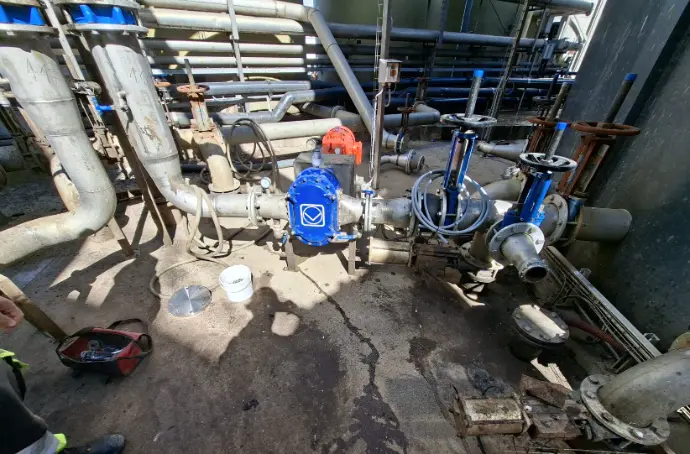
The pump was installed and commissioned on site in a single day in early July, exactly as agreed, by two Vaikon technicians. It has been running since.
The joint inspection that decides how the no cure, no pay agreement plays out is scheduled for October. That's also when the first performance numbers come in, on wear and on how many lobe changes the site has avoided. We'll update this case once the inspection is done.
*Brand names are the property of their respective owners. Vaikon is not affiliated with, endorsed by, or an authorised distributor for these brands. The comparison describes one specific application at one site and is not a general statement about product quality.